

YOU HAD BETTER HOPE THE MODULES ARE ALL UP TO SCRATCH. ONE BADLY DESIGNED PIECE WILL MAKE THE WHOLE MACHINE BADLY DESIGNED.
A source of increased competitiveness and synergies, CMF extends manufacturing commonalisation to an unprecedented number of vehicles developed within the Alliance.
- CMF will generate an average 30-40% reduction in entry cost per model and 20-30% reduction in parts cost for the Alliance.
- CMF will be deployed across 5 continents in more than 10 countries through 2020.
- The first deployment of CMF, for the compact and large car segments, will cover 1.6 million vehicles per year and 14 models (11 Renault group + 3 Nissan).
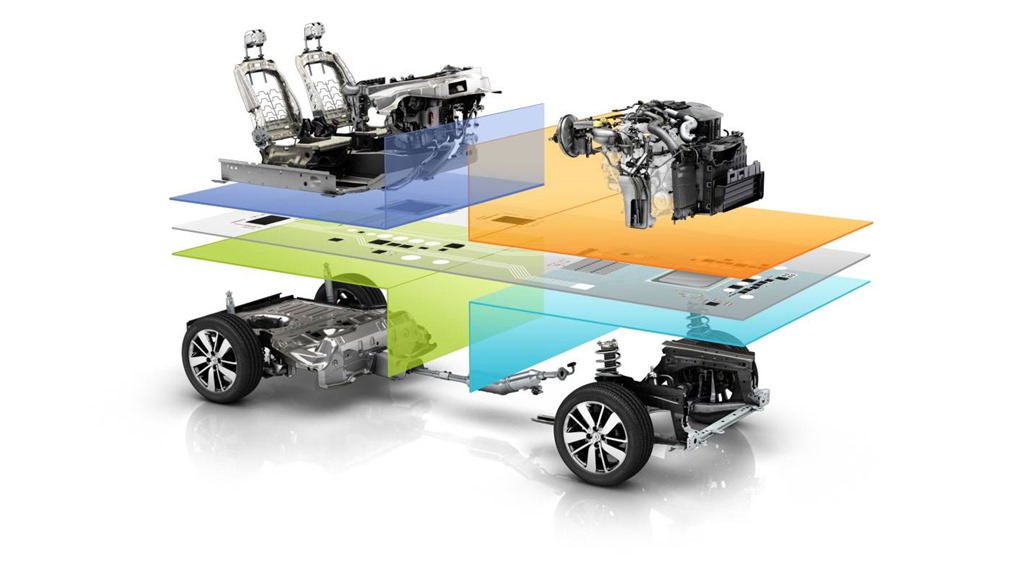
June 20, 2013 – A Common Module Family (CMF) is an engineering architecture that covers Renault/Nissan Alliance vehicles, from one or more segments, based on the assembly of compatible Big Modules: engine bay, cockpit, front underbody, rear underbody and electrical/electronic architecture.
Therefore, a CMF is not a platform; it can involve several platforms. A platform is a horizontal segmentation; a CMF is a cross-sector concept.
For the Alliance: a new stage with different types of vehicles from different segments
CMF is an additional tool that goes further than carryovers on a single platform, to expand the product range. The trend will be to increase the modules common to several platforms with a view to standardizing components and increasing the number of vehicles per platform. CMF will gradually be extended to Renault and Nissan ranges between 2013 and 2020. CMF will be first applied to the compact and large car segments, then to be followed by models in other segments.
CMF for the compact and large car segments: global coverage
CMF for the compact and large car segments will include 1.6 million vehicles per year and 14 models (11 Renault group + 3 Nissan):
- The first Nissan vehicles will be released in late 2013: replacements for Rogue, Qashqai and X-Trail.
- The first Renault vehicles will be released in late 2014: replacements for Espace, Scénic and Laguna
CMF generates economies of scale and lowers costs within the Alliance to meet client demands for product diversity.
CMF will create an “Alliance parts bank” that is just the right size for a varied product range as close as possible to customer needs.
- Sharing and carryover of parts between models and entities generates economies of scale.
- Applying the system throughout volume production of the vehicles guarantees long-term performance.
CMF addresses all items of expenditure, through synergies, shared volumes, economies of scale and shared risks within the Alliance in:
- Component purchasing: a 20%-30% cost reduction for the Alliance
- Investment (a single entry cost): a 30-40% cost reduction in product + process engineering, with variations for Nissan and Renault.
Compared with the savings achieved by commonalisation on the B platform (which was originally intended for Modus and Clio for Renault and Micra for Nissan), CMF generates economies of scale through the unprecedented coverage offered by the Alliance in terms of number of vehicles and geographical regions.
Jean-Michel Billig, Engineering, Quality & IT Director of Renault said: “With CMF, the investments in vehicle architecture and non-visible parts are mutualized, resulting in significant cost reductions that allow us to roll out our innovation policy in terms of environment, safety and new technologies for all our customers.”
Tsuyoshi Yamaguchi, Alliance Director responsible for engineering, said: “CMF opens a new era in engineering synergies for the Alliance. This will enable us to pursue volume efficiencies and introduce attractive new technologies in our products faster than before, creating additional value for our customers.”
The Big Modules must satisfy the pre-requisites of the Alliance Integrated Manufacturing System (AIMS) process
AIMS is a standard, flexible process, which: enables the same product to be manufactured at several different sites or many products to be manufactured at a single site; simplifies planning, facilitates management, enables adjustments to global capacity and lowers entry costs.
When a plant starts manufacturing a new product, AIMS limits the additional investment for the first volume production of a new model.