

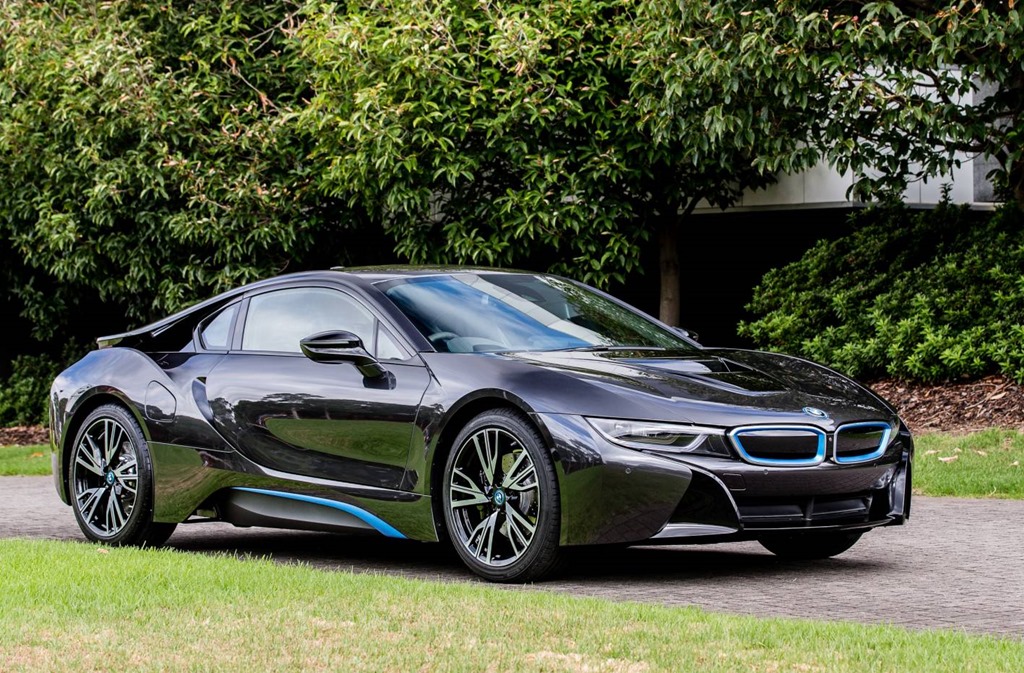
- New generation of sports car featuring visionary mobility, inspiring design and next premium
- The second and ‘halo’ model for the BMW i sub-brand
- High performance and exceptionally efficient plug-in hybrid drive train
BMW Australia today announced the arrival of the visionary new BMW i8, the second and ‘halo’ model unveiled by the new BMW i brand.
Revealing the vehicle at a special preview event in Sydney today, BMW Group Australia managing director, Phil Horton, said the BMW i8 is a trailblazer for a new generation of sports car.
“Showcasing visionary concepts with inspiring design and groundbreaking technology, the BMW i8 represents a new chapter for premium sport cars,” he said.
“It clearly demonstrates the progress BMW i has made towards sustainability and uses unique technological advancements to enhance the BMW hallmark driving enjoyment,” said Horton.
The BMW i8 embodies hallmark BMW driving pleasure in a revolutionary and mould-breaking form. This is reflected in a highly emotive design, dynamic sports car performance, and fuel consumption and emissions figures worthy of a small car. Pairing an exceptionally lightweight, aerodynamically optimised body with cutting-edge BMW eDrive technology, a compact, highly turbocharged 1.5-litre BMW TwinPower Turbo petrol engine and intelligent energy management, the BMW i8 marks the next stage in the evolution of the Efficient Dynamics strategy. Its revolutionary approach achieves an unprecedented balance between performance and fuel consumption.
Thanks to its carbon-fibre-reinforced plastic (CFRP) passenger cell, the BMW i8 sets new standards for a plug-in hybrid vehicle in terms of low weight. It can operate solely on electric power, which means no tailpipe emissions, and offers the dynamic performance of a sports car, with an expected 0 – 100 km/h sprint time of 4.4 seconds.
The LifeDrive architecture specially developed for BMW i vehicles offers the ideal platform for turning the tide of spiralling weight while at the same time achieving distinctive styling exclusive to BMW i. With a length of 4,689 mm, a width of 1,942 mm and a height of 1,293 mm, the BMW i8 has the proportions of a typical sports car. Its dynamic personality is also stressed by a long bonnet, conspicuous aerodynamic features, an elongated roofline, short overhangs and a long wheelbase of 2,800 mm. Characteristic BMW i form language wraps up this groundbreaking combination of sporty performance and efficiency in a charismatic 2+2-seater design.
The BMW i8’s plug-in hybrid system is specific to this model. Developed and produced by the BMW Group, it marks the next step in the evolution of the Efficient Dynamics programme.
Combining a compact 170 kW three-cylinder petrol engine with BMW TwinPower Turbo technology driving the rear wheels and a 96 kW electric motor driving the front wheels, this system offers a combined maximum output and performance of 266 kW and 570 Nm of torque for a 0-100 km/h sprint of just 4.4 seconds. This configuration also offers all-electric driving capability with a range of up to 35 kilometres and a top speed of 120 km/h. With both drive systems engaged, it also offers road-hugging all-wheel-drive performance with powerful acceleration and dynamic torque vectoring during sporty cornering. Calculated using the EU test cycle for plug-in hybrid vehicles, the average fuel consumption of the BMW i8 at model launch will be less than 2.1 litres/100 km with CO2 emissions of less than 49 grams per kilometre.
With this revolutionary concept and the emotional appeal of its aerodynamically optimised body design, the 2+2-seater – which was conceived from the outset as a plug-in hybrid – paves the way for an engagingly dynamic and futuristically efficient take on BMW’s hallmark driving pleasure. By cementing the brand’s new premium character, strongly defined by sustainability, in the sports car segment, the new i8 also demonstrates the broad spread and universal appeal of the BMW i philosophy.
The BMW i8 will be available for demonstration to prospective customers from December 2014 via the BMW i dealer network with customer vehicles arriving from March 2015.
From the commencement of BMW i sales (for the BMW i3 initially) in the last quarter 2014 there will be four BMW i selling dealers operating in Australia; BMW Melbourne in Southbank, Melbourne; BMW Sydney in Rushcutters Bay, Sydney; Brisbane BMW in Fortitude Valley, Brisbane and Auto Classic in Victoria Park, Perth. At the end of the first quarter 2015 a further two sales dealers in Adelaide and Canberra will join the BMW i network.
On top of the authorised BMW i sales dealerships, service and repairs will be available on the BMW i8 through a selection of up to ten existing BMW dealerships all positioned in areas appropriate for BMW i ownership.
Full pricing and specification for the BMW i8 will be communicated closer to the launch.
BMW i8 quick facts
Body
Construction
BMW LifeDrive is the first architecture to be custom-built for electric cars. It is made up of two separate units: The aluminium Drive module consist of the combustion engine and electric motor, battery pack, power electronics, chassis components, and structure and crash functions, while the central element of the Life module is the 2+2-seater’s carbon-fibre-reinforced plastic (CFRP) passenger cell.
This architecture also gives the BMW i8 a very low centre of gravity and a near-perfect 50:50 axle load ratio, both of which increase its agility.
Dimensions
The body measures 4,689 mm in length, 1,942 mm wide, 1,293 in height and rides on a 2,800 mm wheelbase.
The BMW i8 features two doors made of a CFRP inner structure and an aluminium outer skin. These doors open forwards and upwards like wings providing access to the 2 + 2 seating arrangement.
Another aspect that helps to improve the efficiency and agility of the BMW i8 is the unique wheel and tyre combination. The standard 195/50 R20 front wheels and 215/45 R20 rear wheels offer excellent aerodynamic properties and low rolling resistance.
Weighing in at only 1,490 the additional weight of the battery pack and electric drivetrain in the BMW i8 has been more than offset with the comprehensive use of CFRP and light-weight and sustainable materials throughout the vehicle.
Safety
Impressive rigidity, combined with its ability to absorb an enormous amount of energy, makes CFRP extremely damage-tolerant. Even at high impact speeds it displays barely any deformation. The development of the LifeDrive architecture and the version of it used for the BMW i8 incorporated the latest knowledge from safety and accident research and the requirements of international crash test procedures. The high-strength passenger compartment teams up with the intelligent distribution of forces within the LifeDrive module to provide the cornerstones for optimum occupant protection.
Front airbags and side airbags integrated into the seat backrests, plus head/curtain airbags for both rows of seats, are all fitted as standard, as are three-point inertia-reel seatbelts including belt stoppers, belt tensioners and belt force limiters for all seats.
The standard DSC system includes the Anti-lock Braking System (ABS), Dynamic Traction Control (DTC), Cornering Brake Control (CBC), Dynamic Brake Control (DBC), Brake Assist, Brake Standby, Start-Off Assistant, Fading Compensation and the Brake Drying function.
Drive
The BMW i8 is driven by a plug-in hybrid all-wheel drive system, which comprises a BMW TwinPower Turbo engine driving the rear wheels and the BMW eDrive technology electric motor driving the front.
Electric motor
The hybrid synchronous electric motor developed and produced specially by BMW Group for use in the BMW i8 generates 96 kW and a maximum torque of 250 Nm from rest. Also integrated into the electric motor are the power electronics, charger and generator for recuperation mode.
As well as providing a power boost to assist the petrol engine during acceleration, the electric motor can also power the vehicle by itself up to a top speed of 120 km/h. The BMW i8 has a maximum driving range in this emission-free, virtually soundless, all-electric mode of up to 35 kilometres.
Recuperation
Recuperation mode is activated the moment the driver takes his foot off the accelerator where the electric motor switches from drive to generator mode feeding power into the lithium-ion battery.
Combustion engine
The BMW i8 is the first BMW production model to be powered by a three-cylinder petrol engine. Equipped with the latest-generation BMW TwinPower Turbo technology it comprises of a high-performance turbocharging system and direct petrol injection with high-precision injectors positioned between the valves, along with VALVETRONIC. This high performance unit develops maximum power of 170 kW from its 1.5-litre displacement and maximum torque of 320 Newton metres.
Combined these two drive units produce 266 kW of power and a peak torque of 570 Nm.
Charging time
|
BMW i Wallbox |
Domestic socket |
|
3.7kW at 16 amps |
10 amps |
|
1 hour 45 mins |
2 hours 30 mins |
Transmission
The BMW i8 uses a two-speed transmission for the electric drive to the front wheels and a six-speed automatic transmission for the rear.
Performance BMW i8
|
0-100 km/h |
sec |
4.4 |
|
80-120 km/h |
sec |
4.5 |
|
Top speed (electric) |
km/h |
120 |
|
Top speed |
km/h |
250 |
Range
|
Electric |
km |
(approx) 35 |
|
Km |
>500 |
Driving in ECO-PRO and ECO-PRO+ modes can extend the range in each case by up to 20km’s.
Consumption (EU cycle)
|
Fuel/CO2 |
l/100 km / g |
2.1/49 |
Sustainability
Product
Recycled and renewable raw materials used throughout the BMW i8:
- The plastics used for the interior and thermoplastics for the exterior are produced using 25% recycled or renewable materials
- 80% of the aluminium used is either recycled or produced with renewable energy
- The Kenaf, a plant belonging to the cotton family is used in the production of the door panelling and thermal layering
- Seat trims are made of 100% recycled polyester which includes 34% out of PET bottles
- Olive leave extract used to naturally tan the leather and involves ecologically friendly production
- BMW i key consist of sustainable biopolymer, partly made of castor oil bean
Production
- The carbon production plant in Moses Lake USA is powered 100 % by locally generated hydroelectric power and therefore completely CO2 free
- Scrap CFRP is recycled in Wackersdorf and subsequently channelled back into use – in BMW i models, for example. Currently, around 10 per cent of the carbon fibre used in the BMW i8 is recycled material
- The production of the BMW i8 at the Leipzig plant uses 50% less energy and 70% less water than the average figures for BMW Group
- The energy used at Leipzig plant is 100% renewable being generated by four wind turbines installed on site at the plant
ConnectedDrive
Driver assistance systems
- Cruise control with braking function,
- Head up display
- Collision warning with pedestrian recognition and braking function (up to 60 km/h)
- LED Headlights with High Beam Assistant
- Rear view camera
- Surround view
- Park distance control
- Navigation system with Dynamic range display and Driving range assistant
BMW ConnectedDrive remote app
Available for both iOS and Android operating systems. The remote app allows the driver to access vehicle data and relevant information on route planning at any time. Also available via the app is a display of charging station locations overlaid with current driving range. It can also be used to select a specified destination and import it into the vehicles navigation system. Additionally, control of the charge process and preconditioning of the vehicles high-voltage battery can be done remotely via the app.
Another unique function of the BMW i app allows the navigation destination input in the vehicle to be automatically transferred to the BMW i app via the BMW ConnectedDrive server so that route guidance can be continued by smartphone
Discover more from Gay Car Boys
Subscribe to get the latest posts sent to your email.











Leave a Reply