

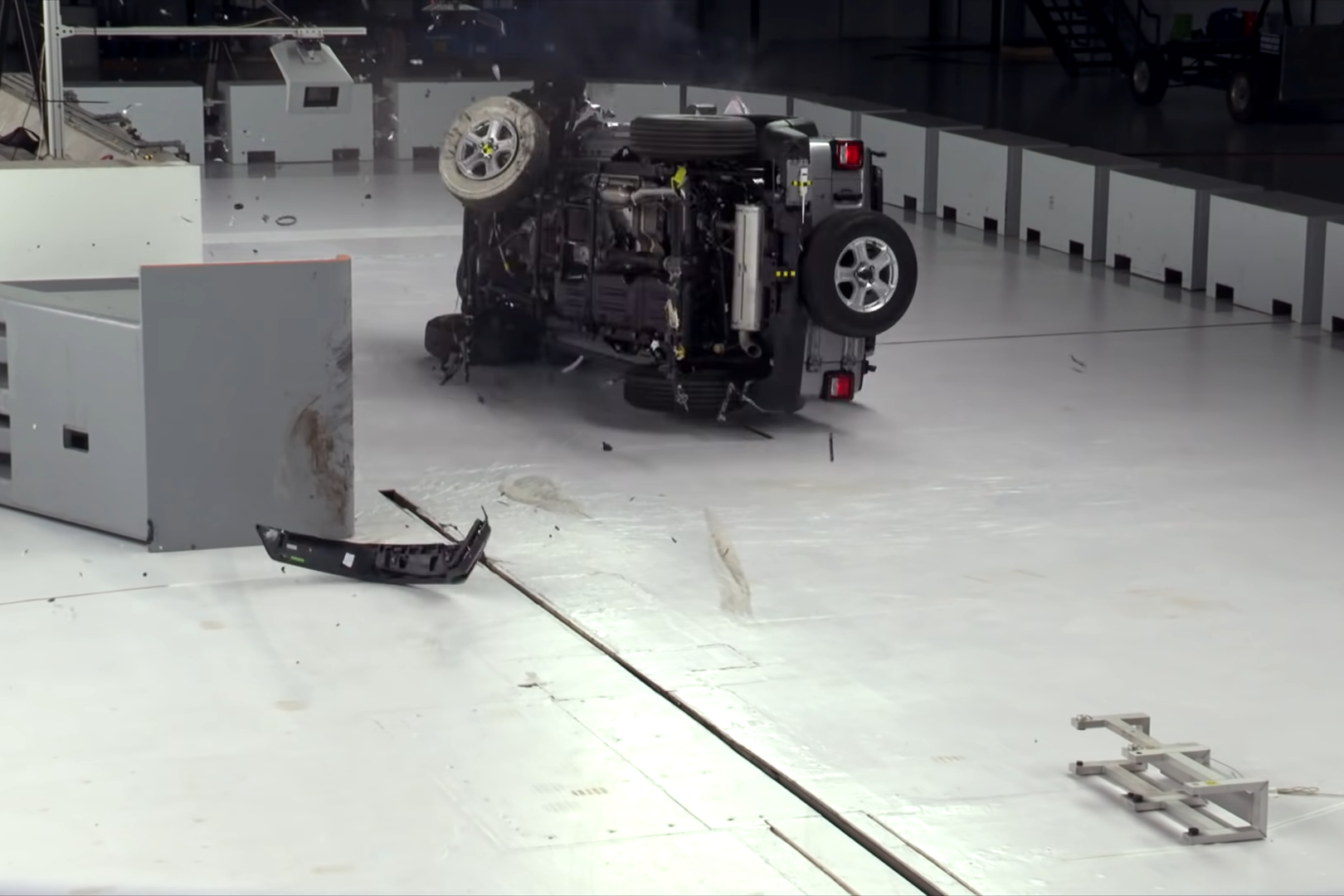
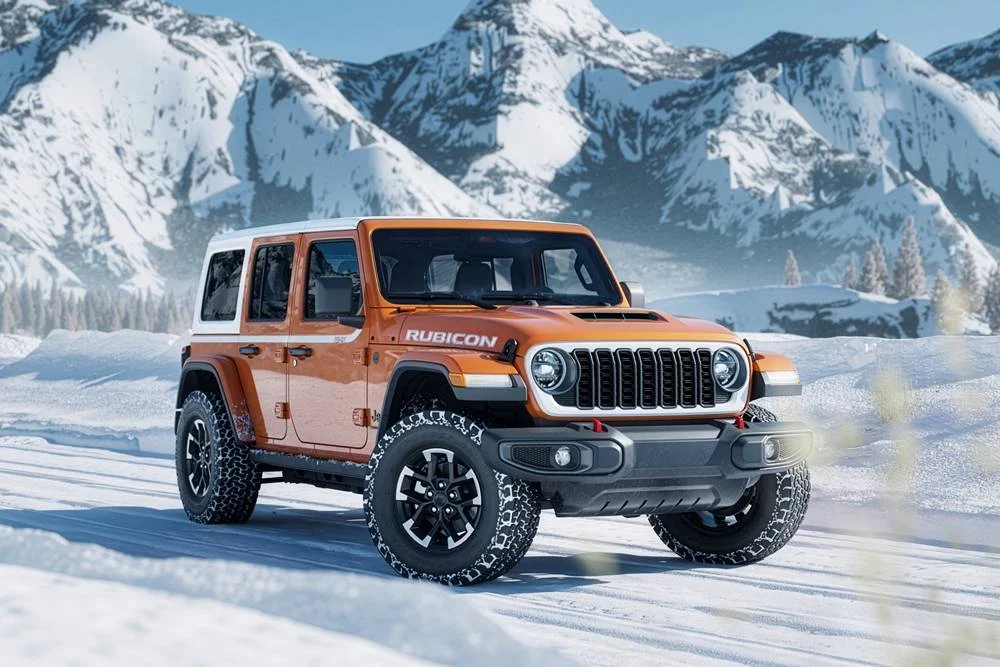
Above: Jeep Wrangler tipped over during crash tests though. SEE THIS article in Jalopnic.
FCA May have reduced the environmental impact, but crash test impacts are a different matter. The Jeep Wrangler floor ripped open in Australian tests, and overturned during USA tests.
In its continuing efforts to monitor and reduce the environmental impact of its vehicles, FCA has completed its latest Global Warming Potential (GWP) analysis.
Other GAYCARBOYS Stories
What about some HOT RACING DRIVERS. Gay? Or just plain gorgeous?
- 10 Hottest Racing Drivers
- Talented Twinks – Callum Ilott Virtually Races Arthur Leclerc
- Handsome Mclaren Drivers at 2020 SRO E-Sport GT Series
- Bentley Motor Sport and it’s Handsome Drivers
- 2019 NASCAR Xfinity Series | 10 Hottest Drivers
- Charles Leclerc Hottest British Grand Prix F1 Driver
The redesigned-for-2018 Jeep Wrangler Unlimited was compared with the previous-generation vehicle, its overall GWP is 15 per cent lower than that of its predecessor.

Help Support Gay Car Boys Subscribe to our Youtube Channel


“This is the outcome we expect when we launch a new vehicle,” says Mitch Clauw, FCA Vice President and Head of Global Pre-Programs and Program Management. “In all our processes, the mitigation of environmental impact is a baked-in consideration.”
The GWP improvement was calculated using industry-standard software that examines multiple factors associated with a vehicle’s design, production and on-road performance. These factors include:
- the environmental impact of fuel production and delivery
- material use
- the vehicle’s own fuel consumption
Determinations are based on 150,000 miles of operation. And improvements are measured by contrasting anticipated C02-equivalent greenhouse-gas (GHG) emissions, with those of comparable vehicles.
C02-equivalent, or CO2e, is a term for describing various greenhouse gases as a common unit. For any quantity and type of greenhouse gas, CO2e signifies the amount of CO2 that would have an equivalent effect on global warming.
In this case, the comparison was made with the previous-generation Wrangler Unlimited, as powered by its only available engine – FCA’s award-winning 3.6-litre Pentastar V-6 – and a since-discontinued five-speed automatic transmission.
The new Jeep Wrangler’s performance was measured as equipped with the available 270-horsepower, 2.0-litre turbocharged I-4 engine, featuring engine stop-start (ESS). Accordingly, each new Wrangler Unlimited has the potential to account for a 14-metric-ton reduction in GHG emissions, which is equivalent to:
- GHG emissions of three passenger cars, driven for one year
- C02e output from 7.7 tons of coal burned in a power-generation plant
- C02e produced when powering 2.4 average American homes for one year
Equally compelling is that the reduced emissions from each 2.0-litre Wrangler Unlimited, over its lifetime, has the potential to account for the carbon sequestration that occurs in 16.5 acres of U.S. forest, over an entire year.
Material choices also contribute to the new Wrangler Unlimited’s greener performance. Its ferrous metal content was reduced to 54 per cent from 68 per cent in the previous-generation vehicle.
Meanwhile, non-ferrous metal content, which contributes to weight reduction and corrosion resistance, increased to 20 per cent, from 12 per cent.
Further improving Jeep Wrangler’s on-road performance, FCA’s TorqueFlite eight-speed automatic transmission benefits fuel economy, whether mated to the 2.0-litre turbocharged I-4 or the 3.6-litre Pentastar V-6. In I-4 configurations, the celebrated transmission helps the 2020 Wrangler Unlimited achieve a 21 miles-per-gallon (mpg) rating in the U.S. Environmental Protection Agency’s combined city/highway test cycle – an increase of three mpg over the previous-generation vehicle and its five-speed automatic transmission.
In the Sahara trim level, the 2020 Jeep Wrangler Unlimited may be equipped with a version of the 2.0-litre turbocharged I-4 that features FCA’s eTorque mild-hybrid technology.
In addition, the new-generation Jeep Wrangler Unlimited is available with a 3.6-litre V-6 from FCA’s award-winning Pentastar engine family. It comes with a choice of a TorqueFlite eight-speed transmission or a six-speed manual gearbox.
The 2.0-litre turbocharged I-4 is also available in the Jeep Cherokee midsize SUV. To accommodate its continued proliferation across the FCA line-up, the Company is committing $400 million to produce the engine at a former transmission plant in Kokomo, Indiana, a project that will bring FCA’s total employment in the state to 8,300.
The results of this latest GWP analysis come on the heels of FCA’s 2019 Sustainability Report. Distributed on April 16, it says the Company further reduced its environmental footprint around the world.
Among the highlights, FCA cut its water use by nearly 40 per cent, compared with 2010. Over the same time period, the Company also shaved its carbon footprint by 27 per cent, and slashed its waste generation by 64 per cent.
Discover more from Gay Car Boys
Subscribe to get the latest posts sent to your email.















Leave a Reply