The Subaru Uncharted arrives as a rebadged Toyota-heavy electric crossover. While the 252kW output and good ground clearance appeal, ergonomic blunders and missing gloveboxes highlight the cost of rushed badge engineering.
PlayStation Names and Toyota Suits
The 2026 Subaru Uncharted arrives carrying familiar Subaru language in a Toyota suitcase. Symmetrical All-Wheel Drive and rally-bred handling meet SUV capability plus vague references to driver engagement. This is Subaru’s third electric vehicle tied heavily to Toyota engineering. First came the Subaru Solterra and its Toyota twin, then came the Trailseeker. Now arrives the Uncharted, an EV sharing everything it owns with the upcoming 2027 Toyota C-HR+.
Subaru and Toyota have had several joint ventures, most notably the BRZ/GR86. This particular joint venture their way of battling Tesla and the Chinese EV juggernauts. The move comes late as Japan carmakers have resisted electric propulsion which allowed other brands to fill a segment neither Toyota nor Subaru have since been able to crack.
Now the C-HR+ arrives in 2027 while Subaru tries to separate itself through chassis feel and capability, but is that enough? Five years ago, an electric SUV simply needed to exist. Now buyers expect range and charging speed while as Chinese manufacturers arrive monthly with another 400kW electric missile wrapped in synthetic leather.
The Uncharted responds differently with Subaru is pitching feel rather than spectacle. Dual electric motors are rated for an adequate 252kW, the ground clearance of 211mm is good for weekends at snowfields, and the 0-100km/h sprint of five seconds is frisky.
Above: Denza B8 Could be the Best SUV on the Market
#denza #ElectricCars #phev #denzab8

Help Support Gay Car Boys Subscribe to our Youtube Channel by SMASHING THE BUTTON ABOVE


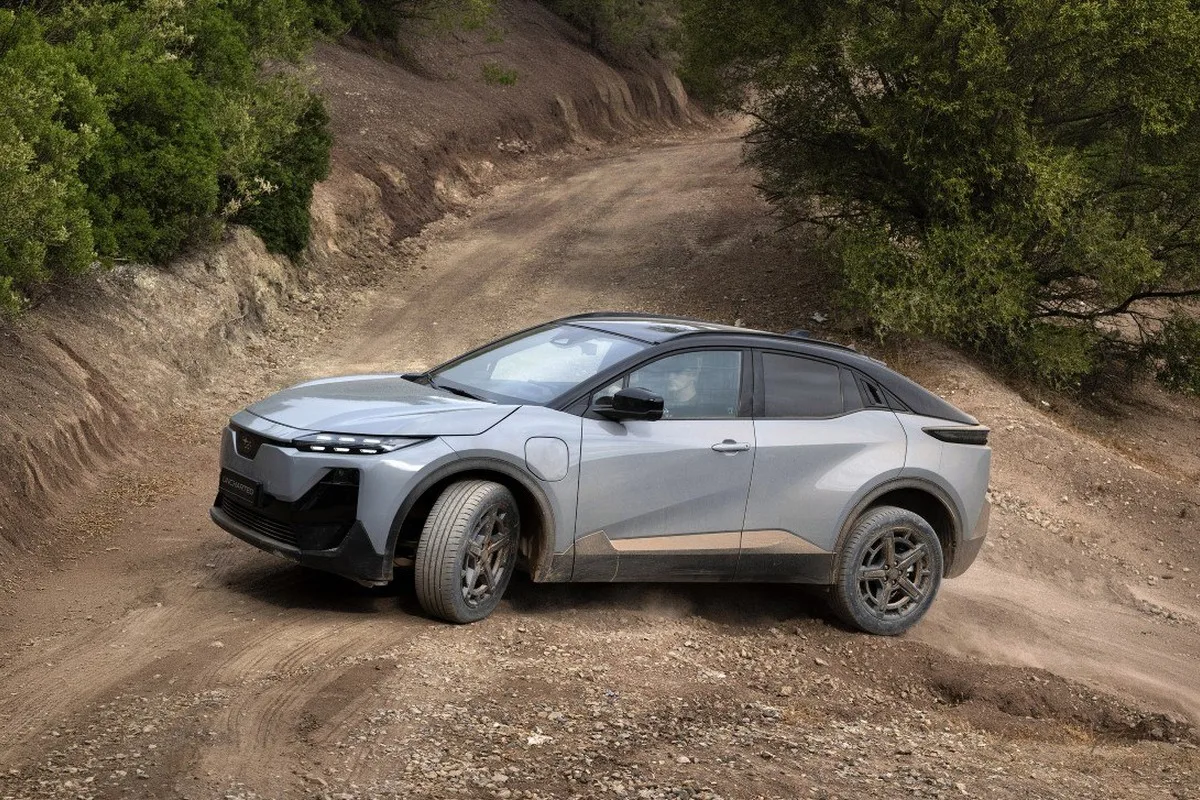


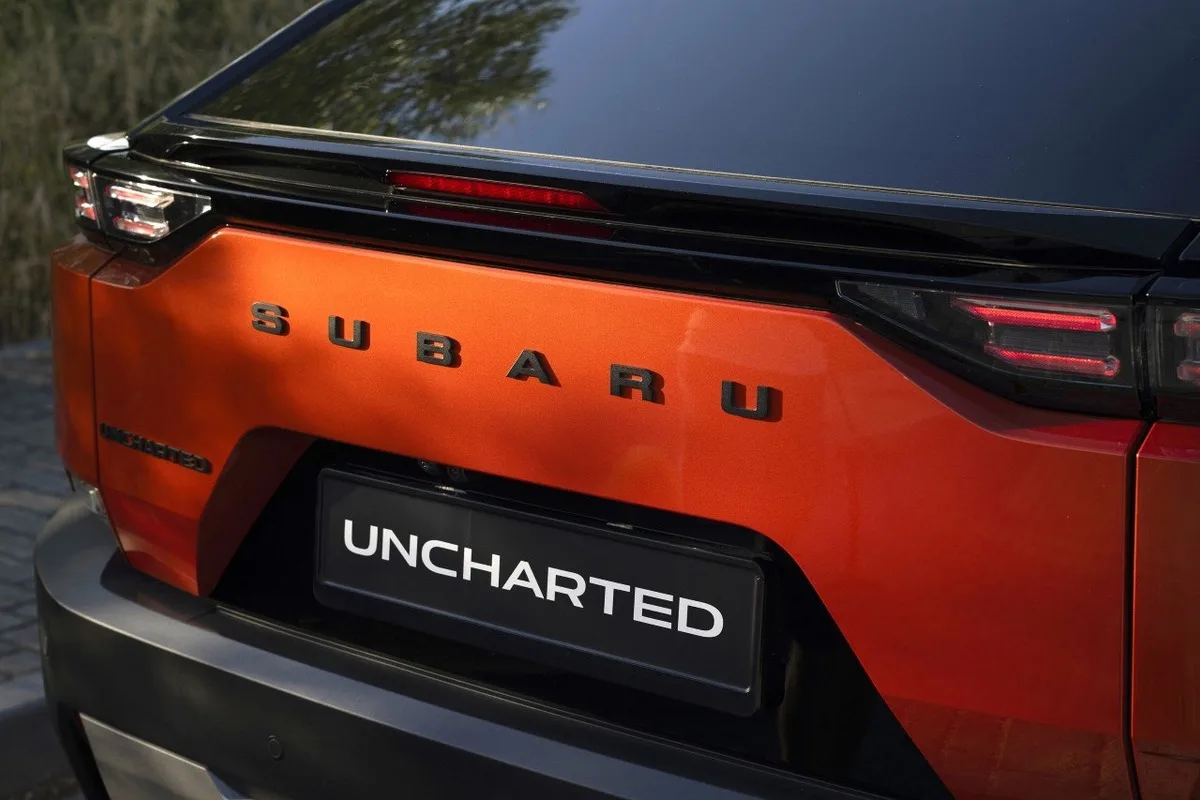

ABOVE: Subaru uncharted – A Toyota C-HR+ Twin
Resolved Design and Shirtless Adventurers
The Uncharted looks more handsome than Solterra ever did. Solterra was trapped awkwardly between futuristic EV styling and an alleged “rugged” SUV image. The roofline slopes sharply rearward in fastback style, and the currently fashionable flush rear door handles clean up the profile while. Changes from the Toyota include LED lighting signatures on the nose and tail but it will all come down to figures and facts.
The name itself leaps from the PlayStation franchise world of shirtless adventurers searching for hidden treasure somewhere off the coast of Mykonos. Shirtless sounds great, in theory.
The Cockpit of Questions
The cabin goes tech-focused with the obligatory 14-inch touchscreen and a 7-inch driver display. Wireless Apple CarPlay and Android Auto come standard alongside dual wireless phone chargers. Subaru retained physical controls for important functions. That should not qualify as innovation but modern car interiors have become so obsessed with touchscreen minimalism that the simplest of functions involves spelunking through menus while the car warns you that you’re distracted. Well, of course you are, it is the car that is distracting you.
A sixty thousand grand car should bring basic ergonomics that are flawless. Instead, the shared e-TNGA platform forces drivers to adapt to the car. Two glaring cabin decisions ruin the daily ownership experience. Open the front passenger door and you are greeted by a smooth plastic wall where a traditional glove compartment should be. Designers completely deleted the glovebox to maximize front passenger legroom. EVs should, and do, feel more spacious with less given over to mechanical frippery, so at least the floor is flat.
Subarus asks you to plonk you logbooks and loose charging cables onto the open tray underneath the floating center console. Not only does this leave your valuable belongings visible to anyone walking past your parked car, but items inevitably slide around during spirited cornering.
The Gauge Cluster and the Squircle
The driver’s view is equally problematic. In a stupid idea seen in Peugeot, rather than fitting a traditional instrument binnacle behind the steering wheel, the designers mounted a 7-inch digital screen far forward near the base of the windscreen. Because the screen is pushed so far back, the top rim of a standard steering wheel completely blocks the speedometer for drivers of average height. To fix this fundamental geometry mistake, the brands had to introduce a bizarre, squarish steering wheel known as a squircle.
To see how fast you are going without the top of the wheel cutting off the numbers, you are forced to adjust the steering column unnaturally low. It is an ergonomic failure that makes the vehicle feel awkward and uncoordinated.
Rear seat practicality includes reclining seats backs and SUV ride height.
Capability
The 252kW dual-motor driveline allows immediate and controlled response rather than simply violent, says Subaru.
As with almost all EVs, the (74.7kWh CATL) battery sits low within the structure helping centre-of-gravity and handling response. Decent ground clearance of 211mm also gives the Uncharted usability on easy tracks, and X-Mode and Grip Control give the impression of being able to go further afield than is wise. Capability still matters psychologically to Subaru buyers who like knowing the car could survive a muddy campsite occupied by shirtless men cooking halloumi over portable gas burners.
Now for the Financial Decay and the Sales Eviction News
Do the flaws inside these cabins mirror a deeper corporate chasm? For years, Japanese legacy brands masked their slow electrification strategies with record volume sales. In May 2026, the global balance sheets have given them cause to uncross their legs and lean forward. Toyota’s operating income is projected to drop down to 3.0 trillion yen to wipe out billions in earnings despite high volumes of legacy hybrid vehicles.
Subaru’s position is even more dire. The brand shocked some in the market by slashing its operating profit dreams by a chronic 90%. This financial collapse was driven directly by crushing impairment losses on its stagnant battery EV assets. With aging models, sales dropping across the board, it seems ubaru has exited the Top 10 forever. Subaru was driven out by tech-forward Chinese juggernauts like BYD,
Set Against Chinese Value
At $59,990 before on-road costs, the Uncharted enters a snarky EV playround. Rivals from BYD and Zeekr offer lower pricing and long tech lists. The Subaru does hold an advantage in raw battery capacity and an excellent 211mm of ground clearance. But these highlights are heavily overshadowed by the vehicle’s glaring daily usability flaws.
The Chinese alternatives treat a $60,000 budget a little more generosity. The MG4 XPower offers supercar-level acceleration for the exact same money. The Zeekr X’s high-density foam seating and premium materials that make the Subaru’s cabin feel slightly bargain basement. If you are a die-hard Subaru fan who demands a long-range EV capable of driving down a rutted fire trail, the Uncharted’s mechanical package will no doubt do the job. But you must be willing to accept a compromised driving position and a missing glovebox. Paying $59,990 plus on-roads for a vehicle with such obvious interior design oversights is a tough pill to swallow. The Chinese competition is serving up faster and more luxurious options for the exact same spend.
Subaru VS Toyota
Aside from the badge on the steering wheel, these are the only physical hardware changes you will find.
Exterior Sheet Metal & Trim
- The Nose: The Uncharted has a textured hexagonal plastic insert where a grille would usually be. The CHR+ uses a smooth, body-coloured “Hammerhead” panel with no texture.
- Headlight Signatures: Subaru uses a “C-shape” LED daytime running light. Toyota uses a “Hook” or “J-shape” LED strip that bleeds further into the front wing.
- Wheel Arch Cladding: The Subaru has much larger, squared-off matte plastic guards. The Toyota uses slimmer, gloss-black circular arches.
- Rear Lighting: The CHR+ has a continuous light bar that spans the entire tailgate. The Uncharted breaks that bar in the centre to make room for the Subaru logo.
Interior Hardware
- The Centre Console: The Uncharted has a row of physical toggle switches for the X-Mode terrain system and camera views. The CHR+ replaces these with a flat, touch-sensitive panel.
- Button Count: Subaru kept physical buttons for the front and rear demisters and the volume knob. Toyota moved the volume to a touch-slider on the steering wheel and a sub-menu on the screen.
- Upholstery: Subaru uses “StarTex” (a water-repellent synthetic) which feels like a wetsuit. Toyota uses a mix of recycled fabric and “SofTex” leatherette which is softer but harder to clean.
Mechanical Tuning
- Suspension: The Uncharted has a unique damper tune with $10mm$ more travel to handle corrugated dirt roads. The CHR+ is valved stiffer to reduce body roll on sealed suburban roundabouts.
- Steering Weight: Subaru programmed more resistance into the electric power steering rack to mimic a mechanical feel. The Toyota is tuned to be “one-finger” light for easier parking.
- Drive Modes: Subaru includes X-Mode (Deep Snow/Mud presets). Toyota uses Predictive Efficient Drive, which uses GPS data to decide when to coast or use regen braking.
Uncharted AWD Price and Specs
- Price $59,990
- Panoramic Roof Option $1,200
- Power 252kW
- Battery 74.7kWh CATL lithium-ion
- Drive Dual-motor AWD
- Acceleration ~5.0 seconds
- Range Up to 522km WLTP
- DC Charging Up to 150kW
- Ground Clearance 211mm
EV PRICE COMPARO: 2026 SUBARU UNCHARTED VS 10 KEY ALTERNATIVES (AUSTRALIA)
| # | Model | Ground Clearance | Platform | Battery | Max DC | Max Power | Price (approx. AUD) |
| 1 | Subaru Uncharted | 211mm | 400V | NMC | 150kW | 252kW | $59,990 (MSRP) |
| 2 | Toyota C-HR+ | 185mm – 203mm | 400V | NMC | 150kW | 252kW | $58,440 (MSRP) |
| 3 | Kia EV5 (Earth AWD) | 175mm | 400V | LFP | 127kW | 230kW | $68,990 (D/A) |
| 4 | Hyundai Ioniq 5 (Epiq) | 160mm | 800V | NMC | 230kW | 239kW | $91,800 (MSRP) |
| 5 | BYD Sealion 8 (DM-P) | 175mm | 400V | LFP | 150kW | 390kW | $63,990 (MSRP) |
| 6 | Tesla Model Y (Perf) | 167mm | 400V | NMC | 250kW | 393kW | $89,400 (MSRP) |
| 7 | Polestar 4 (Dual Motor) | 166mm | 400V | NMC | 200kW | 400kW | $88,350 (MSRP) |
| 8 | Volvo EC40 (Dual Motor) | 175mm | 400V | NMC | 150kW | 300kW | $85,990 (MSRP) |
| 9 | Mustang Mach-E (GT) | 147mm | 400V | NMC | 150kW | 358kW | $89,000 (D/A) |
| 10 | MG 4 XPower | 137mm | 400V | NMC | 140kW | 320kW | $47,990 (D/A) |
The uncomfortable takeaway
The Subaru sits in a weird middle ground:
It’s not cheap enough to win on value.
It’s not fast enough to win on bragging rights.
It’s not futuristic enough to win on tech.
It’s not premium enough to win on luxury.
What it does have is AWD credibility and Subaru branding — which is basically asking Australians to pay for emotional reassurance in a segment now driven by spec sheets that behave like arms races.
Gaycarboys Subaru Stories
- Subaru Trailseeker vs Chinese EVs as Solterra sales slide
- 95 2026 Subaru BRZ Kiiro Edition Heading to Australia
- 2026 Subaru Forester Hybrid Sport AWD VS GWM H6 PHEV Ultra
- 2026 Subaru Forester Sport Hybrid Review: Charm, Space & Reality
- Nico’s 2026 Subaru Forester Review: A Hybrid SUV Reality Check
- 2026 Subaru Forester Hybrid Review: 5-Minute Read
- 2026 Subaru Outback Arrives With Butch New Brutalist Styling
- 2026 Subaru Solterra get More Power and Range at last
- 2026 Subaru Solterra EV Arrives in USA with Upgrades
Help Support Gay Car Boys Subscribe to our Youtube Channel

Alan Zurvas is the founder and editor of Gay Car Boys, Australia's leading LGBTQI+ automotive publication. Before launching GCB in 2008, Alan's automotive writing was published in SameSame.com.au and the Star Observer. With over 16 years of hands-on car reviewing experience, Alan brings an honest, irreverent voice to every review — championing value and innovation over brand loyalty.
Leave a Reply