

Nico, Max, Luca and I spent the week with three very different beasts: the 2026 Subaru Forester Hybrid Sport AWD, the GWM H6 PHEV Ultra, and the $57,000 (+ on‑roads) BYD Sealion 7 EV ute. It was a proper automotive ménage à trois — one SUV, one PHEV SUV, and one ute that thinks it’s an SUV if you squint hard enough. In part 1 we look at the Subaru, part two next week.
We’d gone into this test with a healthy dose of cynicism. For years we’ve rolled our eyes at PHEV fuel claims — the whole “just plug it in and you’ll get 1L/100km” fantasy. We assumed the numbers were cooked, the cycles were unrealistic, and the real world would expose the truth.
We were wrong, if and only if, you can plug in at home daily.
And the boys have been insufferable about it.
The Shark was fabulous in its own chaotic, ute‑ish way, but without a canopy it’s not a serious option for SUV buyers. Max loved it purely because it made him feel like he should be wearing hi‑vis and yelling “yeah mate, chuck ‘er on the tray.” Meanwhile, we’d just come off the BYD Sealion 7 EV — nearly $68k drive‑away and cross‑shopped against a RWD Tesla Model Y — which only reinforced the seismic shift happening in the automotive landscape. Chinese brands aren’t nibbling at the edges anymore; they’re carving out whole sections of the buffet.
And yes, you can absolutely nab a full EV for roughly the Subaru’s near‑$58k drive‑away price, but for this comparison we’re sticking to vehicles that still offer a dinosaur‑boosted hybrid or PHEV experience. That leaves us with the Subaru and the Haval (or GWM, depending on who you ask — Luca insists on calling it “the G‑Dub” because he thinks it sounds like a rapper).
Some will say it’s unfair to compare a PHEV to a full hybrid. We disagree.
As Nico put it:
“If they both sip and zip, compare the buggers.”
Both are AWD.
Both have petrol engines and electric motors.
Both can drive in EV mode.
Both store energy in a battery.
And as you’ll see in the mega‑table below, the overlap is far greater than the marketing departments would like you to believe.
Design & First Impressions
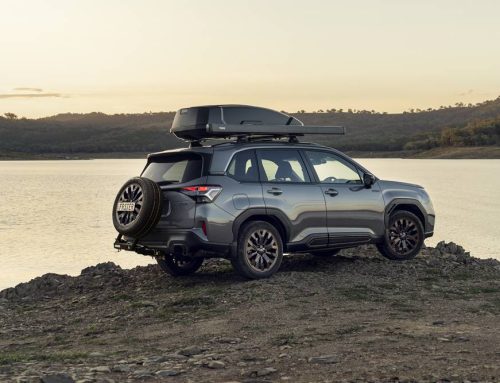
The Forester is a brand‑new model and borrows heavily from Toyota’s hybrid playbook — part of the ongoing Subaru/Toyota symbiosis that’s already given us BRZ/86 and Solterra/bZ4X. The GWM H6 PHEV launched shortly before the Forester, and there’s even a GT variant that looks snazzier again. Luca saw the GT and immediately declared it “the influencer spec,” which is his highest compliment.
Both will appeal to the same crowd, but they go about it differently. Subaru has gone boxier, but it’s visually busier than the slightly larger H6. Although they’re similar in height, the Forester has a shorter wheelbase and overall length. The H6’s cleaner, more modern profile appealed to all four of us — even Max, who usually defaults to “whatever looks toughest.”
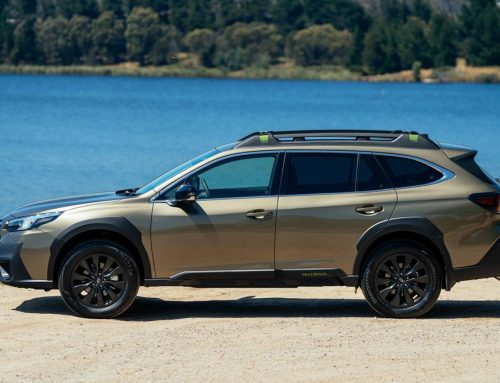
Your Subaru video review will sit beautifully here — the walkaround, the stance, the bronze wheels, the new face. The H6 photos will contrast it perfectly: smoother lines, more premium surfacing, a more cohesive silhouette.
Interior — Space, Screens & Skylights
Inside, the difference is chalk and cheese. Both are spacious and both have delicious opening sunroofs, but the H6’s glass extends right back over the rear seats and the opening section is far larger than the Forester’s polite little aperture. Luca called the Forester’s sunroof “a suggestion,” while the H6’s was “a proper skylight.”
The Subaru’s cabin is classic Subaru: practical, ergonomic, and built for people who want their car to feel like a companion rather than a gadget. The 11.6″ portrait screen is crisp, the full LCD cluster is finally here, and the materials feel honest, but very busy while being a little dull.
The H6, meanwhile, is the gadget.
- Two 12.3″ screens.
- Ambient lighting.
- Ventilated seats.
- Head Up Display.
- Mirco filtering AC System
- A panoramic roof that feels like a conservatory.
It’s the spec‑sheet show‑off — and it knows it.
Haval H6 PHEV Spec Sheet S: h6_brochure_au
Subaru Spec Sheet: 2026 Subaru Forester
And here’s where the value story starts to bite:
For $8,500 less than Subaru’s second‑from‑top Sport Hybrid trim, you get the H6 Ultra AWD PHEV — and as you’ll see in the table below, the H6 doesn’t just match Subaru on features… it steamrolls it in several categories.
Above: 2026 Subaru Forester Hybrid Sport review with real‑world fuel results and comparisons to the GWM H6 PHEV and BYD Shark. How Subaru’s new hybrid really performs.
#SubaruForesterHybrid, #2026Forester, #ForesterHybridSport, #SubaruHybrid, #SubaruReview, #ForesterReview, #GWMH6PHEV, #H6UltraPHEV, #BYDSharkPHEV, #HybridSUV, #SUVReviewAustralia, #CarReviewAustralia, #ForesterHybrid2026, #StrongHybrid, #AWDSUV
, #GayCarBoys


ABOVE: 2026 Subaru Forester Hybrid Sport review with real‑world fuel results and comparisons to the GWM H6 PHEV and BYD Shark. How Subaru’s new hybrid really performs
| Category | Item | Haval H6 Ultra PHEV AWD | 2026 Subaru Forester Hybrid Sport AWD |
|---|---|---|---|
| PRICING | |||
| Pricing | Price (AU) | $46,490 (ex‑on‑roads) | $54,990 MRLP |
| ENGINE & HYBRID SYSTEM | |||
| Engine | Engine type | 1.5L turbo petrol + dual electric motors | 2.5L Boxer petrol + 90 kW electric motor (full hybrid) |
| Hybrid System | Hybrid type | PHEV (plug‑in hybrid) | Full hybrid (parallel) |
| Hybrid System | Battery | 19.09 kWh LFP | Lithium‑ion hybrid pack |
| PERFORMANCE | |||
| Performance | Combined power | 268 kW | 145 kW |
| Performance | Subaru petrol engine output | 136 kW / 239 Nm | |
| Performance | Subaru electric motor output | 90 kW (torque not published) | |
| Performance | Torque | 760 Nm | 276 Nm (electric) + 212 Nm (petrol) |
| Performance | Transmission | Dedicated hybrid auto | Lineartronic CVT |
| Tech | Head‑up display | Yes (full windscreen HUD) | No |
| FUEL ECONOMY & EV RANGE | |||
| Efficiency | Fuel economy (combined) | 1.0–1.1 L/100 km (NEDC) | 6.2 L/100 km (ADR) |
| Efficiency | EV range | 100–106 km (NEDC) | N/A (non‑PHEV) |
| DIMENSIONS | |||
| Dimensions | Length | 4703 mm | 4655 mm |
| Dimensions | Width | 1886 mm | 1830 mm |
| Dimensions | Height | 1730 mm | 1730 mm |
| Dimensions | Wheelbase | 2738 mm | 2670 mm |
| Dimensions | Ground clearance | ~170 mm | 220 mm |
| TOWING | |||
| Towing | Braked towing | 1500 kg | 1200 kg |
| EXTERIOR | |||
| Exterior | Wheels | 19" alloys | 19" bronze alloys |
| Exterior | Sunroof | Panoramic sunroof (standard) | Electric sunroof |
| Exterior | Headlights | LED | Self‑levelling LED + SRH |
| Exterior | Spare wheel | Space‑saver | Puncture repair kit |
| INTERIOR – DISPLAYS & INFOTAINMENT | |||
| Displays | Digital cluster | 12.3" full LCD | 12.3" full LCD |
| Displays | Infotainment screen | 12.3" touchscreen | 11.6" touchscreen |
| Tech | CarPlay / Android Auto | Wireless | Wireless |
| Audio | Sound system | 6 speakers | 10‑speaker Harman Kardon |
| INTERIOR – SEATS & TRIM | |||
| Seats | Seat trim | Leather | Water‑repellent cloth |
| Seats | Seat heating | Heated front seats | Heated front seats |
| Seats | Seat ventilation | Ventilated front seats | Not available |
| Seats | Driver seat | 8‑way power + memory | 8‑way power + memory |
| Seats | Passenger seat | 8‑way power | 8‑way power |
| INTERIOR – COMFORT & CONVENIENCE | |||
| Comfort | Climate control | Dual‑zone + rear vents | Dual‑zone + rear vents |
| Comfort | Wireless charging | Yes | Yes |
| Comfort | Ambient lighting | Yes | Not specified |
| Convenience | Powered tailgate | Yes | Yes (kick sensor) |
Driving — The Real‑World Test
This is where the boys got loud.
The Forester Hybrid Sport is classic Subaru: predictable, composed, and beautifully calibrated. The steering is light but accurate, the ride is supple, and the chassis feels like it’s been tuned by people who actually drive. Luca said it felt “like a Labrador that’s done obedience school.”
The H6 Ultra PHEV is a different beast entirely.
It’s fast.
Shockingly fast.
The torque hits like a wave and the hybrid auto avoids the CVT drone that Subaru still can’t quite escape. But the H6 is heavier, and you feel it. The ride is good, but not Subaru good. The steering is fine, but not Subaru fine.
Max summed it up perfectly:
“The H6 is the one you take to impress someone. The Subaru is the one you take home to mum.”
Hybrid & Efficiency — The Plot Twist
Here’s the kicker:
Both cars hit their advertised fuel figures.
The H6 Ultra PHEV delivered its claimed numbers when driven as intended — plug in, commute, repeat — and the Forester Hybrid Sport matched Subaru’s ADR figures with zero drama.
This is rare.
This is impressive.
This is the part where we all shut up and admitted we were wrong.
Value — The Elephant in the Room
The H6 Ultra PHEV is cheaper.
Better equipped.
More powerful.
More luxurious.
And capable of EV‑only commuting.
The Forester Hybrid Sport is more expensive.
Less powerful.
Less flashy.
But more refined.
More predictable.
More confidence‑inspiring.
And backed by Subaru’s reliability and resale.
Nico put it best:
“The H6 is the bargain. The Subaru is the investment.”
Verdict — Two Winners, Two Philosophies
The H6 Ultra PHEV is the spec‑sheet bully of this comparison. It’s bigger, stronger, torquier, flashier, and cheaper. It’s the kid who turns up to school with a new iPhone, a better lunchbox, and a smug grin because he knows he’s winning.
The Forester Hybrid Sport is the grown‑up. It’s the one you trust to get you home in a storm, the one that won’t squeak or rattle in five years, the one that feels engineered rather than assembled.
If you want maximum features, maximum EV running, and maximum bang‑for‑buck, the H6 Ultra PHEV is the obvious pick.
If you want maximum trust, maximum composure, and maximum long‑term confidence, the Forester Hybrid Sport is still the benchmark.
Two very different personalities — both delivering exactly what they promise.







Leave a Reply