The British car industry has been retreating for years. February 2026 proves the withdrawal is now a rout.
New figures from the Society of Motor Manufacturers and Traders (SMMT) show total vehicle manufacturing in the UK fell 17.2% year-on-year in February 2026, with 68,061 units rolling off the line compared to 82,183 in February 2025. Year-to-date, the picture is no prettier: 135,476 units built so far in 2026, down 15.4% on the same period last year.
These are not rounding errors. They are sustained, significant losses. And they have a name.
The Collapse That Cannot Be Explained Away
The commercial vehicle figures are where the real horror show lives. In February 2025, British factories produced 8,369 commercial vehicles. In February 2026, they managed 2,176. That is a 74.0% collapse in a single month. Year-to-date commercial vehicle production stands at 4,342 units, down 71.6% on the same stretch of 2025.
To put that in perspective: for every four vans, trucks, and commercial vehicles built in early 2025, British industry is now making one.
One.
A 74% drop is not a demand dip. It is structural. Whether that reflects a major model changeover, a production hiatus for retooling, or something more troubling about the fundamental health of British van and truck manufacturing, the SMMT data doesn’t fully explain. And that ambiguity is itself unsettling.
Above: ICE, Hybrid, PHEV, EV — Which Drivetrain Is Right for You? Review
#EUFTA #LuxuryCarTax #FCAI #FreeTradeAgreement #AustraliaTrade

Help Support Gay Car Boys Subscribe to our Youtube Channel by SMASHING THE BUTTON ABOVE


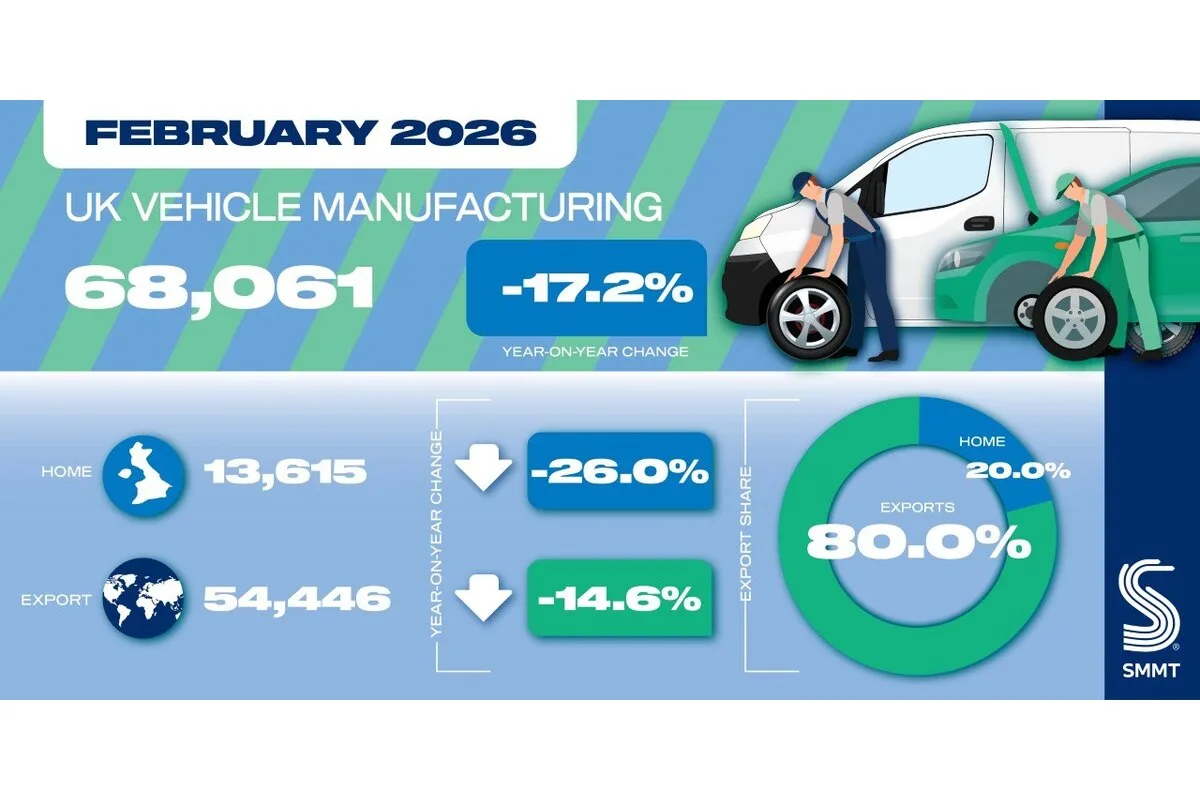
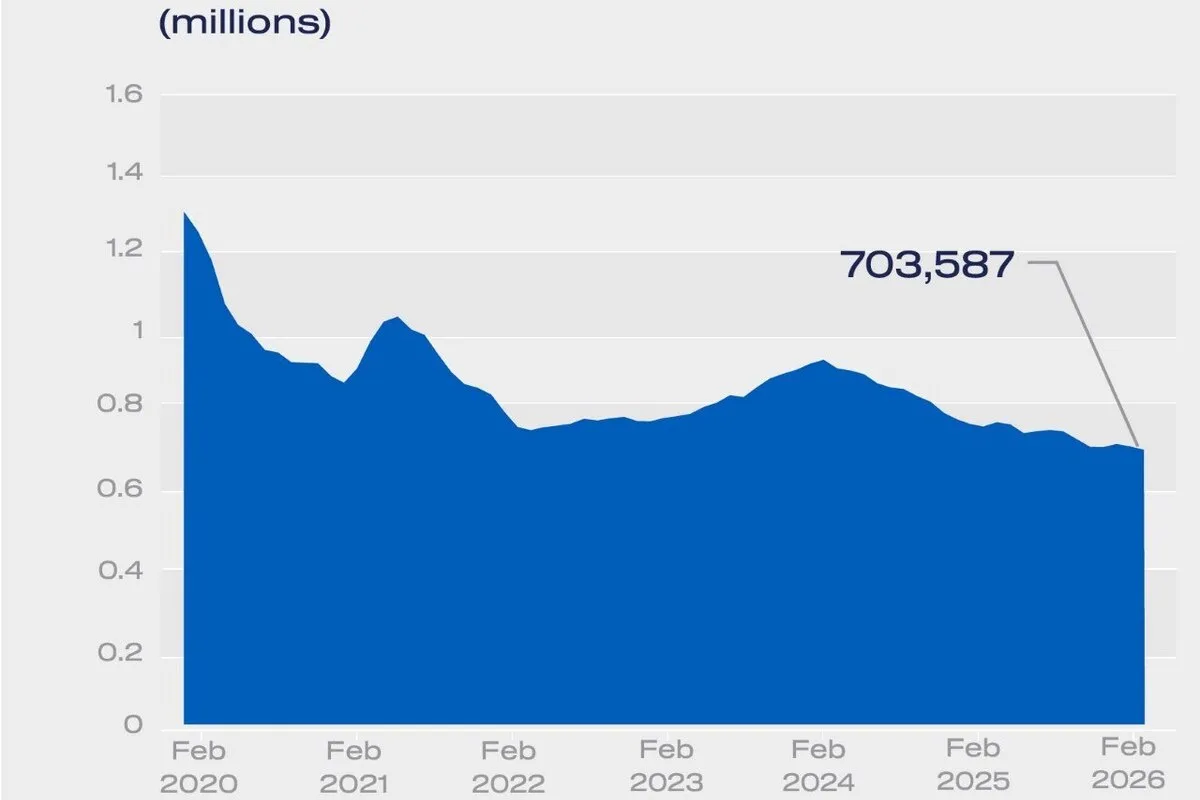
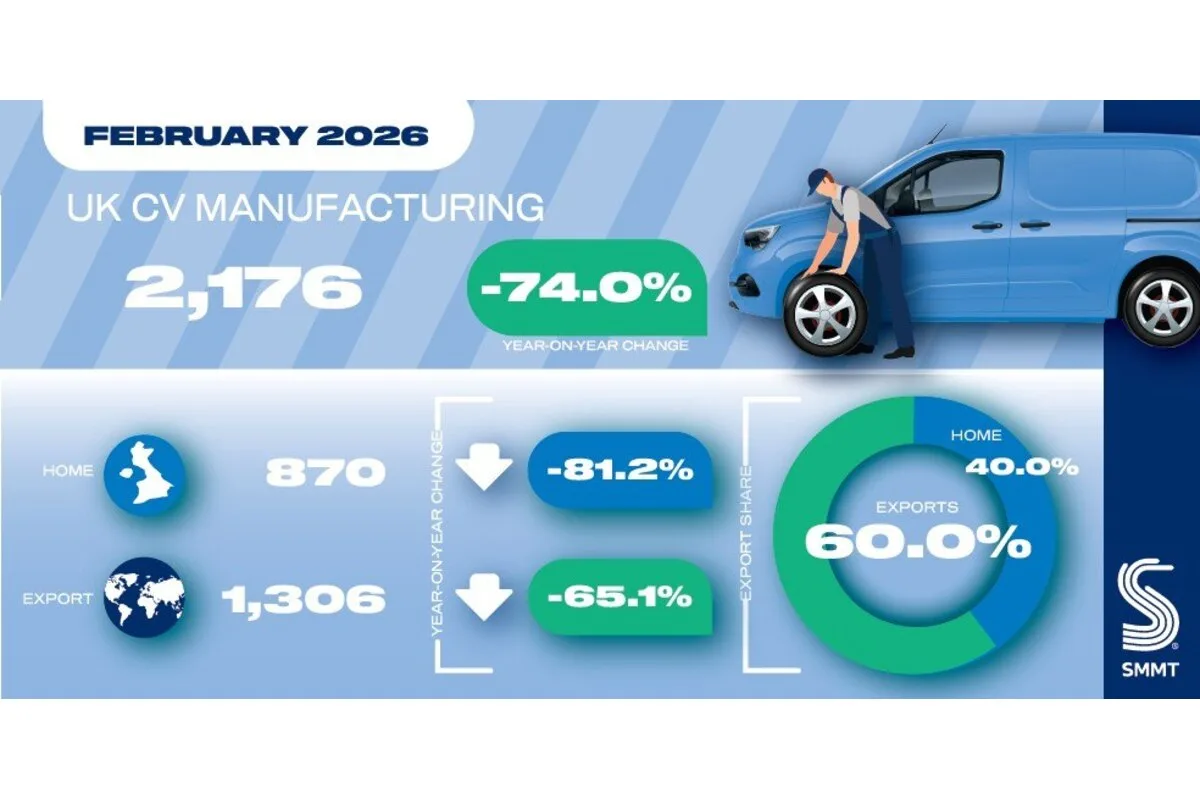
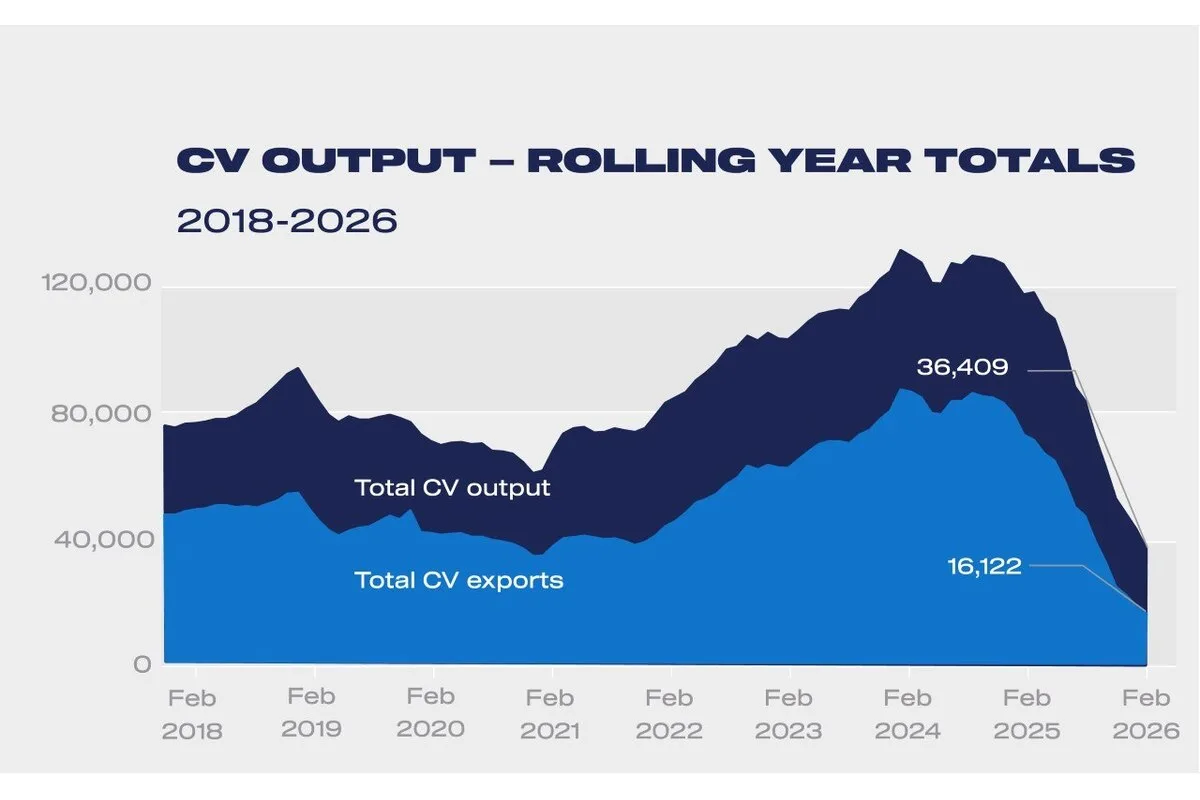
ABOVE: UK Vehicle Manufacturing February 2026 infographic, UK car output rolling year totals chart, UK CV manufacturing detail, UK CV output rolling year chart
How Much Does the UK Car Industry Drop in February 2026?
Passenger car production fared better than commercial vehicles, though “better” is doing quite heavy lifting there. February car output came in at 65,885 units, down 10.7% on February 2025’s 73,814. The year-to-date figure of 131,134 cars represents a 9.5% decline compared to the same two months of 2025.
Domestic car sales fell 7.5%, while export volumes dropped 11.5%, though exports still account for 80.7% of all passenger cars built. A reminder that British manufacturing is largely producing vehicles for other people’s roads.
For total vehicle manufacturing, domestic demand fell 26.0% while exports declined 14.6%. Four in every five vehicles built in Britain — precisely 80.0% — were destined for foreign shores. Which means this country is primarily building for someone else’s market while its own consumers drift elsewhere. There is something quietly dispiriting about that arrangement.
Blame Arrives in Familiar Uniforms
Explanations for British industry’s malaise are not difficult to find. They simply require honesty about their origins.
Brexit’s long tail continues to whip. The administrative friction, tariff complexity, and supply chain disruption created by Britain’s departure from the EU’s single market has never been fully priced in by optimists. Components cross borders more slowly. Partnerships built over decades have been quietly restructured. Investment decisions that might have planted new production lines in Sunderland or Birmingham have been deferred, then cancelled. The factories that did survive have operated under a cloud of uncertainty that discourages the kind of long-term capital commitment modern manufacturing requires.
Alongside Brexit sits the EV transition, a battlefield British manufacturers are scrambling to navigate with insufficient ammunition. The shift away from internal combustion engines demands retooled factories, retrained workforces, and battery supply chains that do not yet exist domestically. The Zero Emission Vehicle mandate requires that an increasing percentage of manufacturers’ UK sales be electric, but the market hasn’t followed the mandate’s ambitions. Consumers remain hesitant. Charging infrastructure is patchy outside major cities. And the vehicles themselves, produced by legacy makers scrambling to catch up, rarely inspire the kind of desire that opens wallets.
What Are UK Car Manufacturing Figures Compared to China?
Meanwhile, on the other side of the world, the Chinese automotive machine watches with quiet satisfaction.
BYD, SAIC, Chery, and their peers didn’t spend years arguing about trade arrangements or agonising over which factory to electrify first. They built. China’s manufacturing capacity isn’t retreating — it is advancing with the confidence of a force that has already mapped the terrain. The comparison isn’t flattering for Britain, but it is instructive. While the UK debates and delays, its competitors are producing at scale, iterating at speed, and exporting at prices that make European legacy makers nervous in their boardrooms.
British-built vehicles overwhelmingly head overseas — that 80% export figure underscores how dependent the industry is on foreign demand. The moment those foreign markets have better, cheaper alternatives, the case for importing British-built vehicles weakens considerably.
The Numbers Don’t Lie
What is not ambiguous is this: the first two months of 2026 have produced 135,476 vehicles from British factories. At the same point in 2025, the tally was 160,195. That is 24,719 fewer vehicles built. Twenty-four thousand, seven hundred and nineteen units of lost production, lost revenue, and lost work.
Britain’s automotive sector does retain genuine strengths. Jaguar Land Rover’s dramatic reinvention as an EV-forward luxury house, the continued excellence of Rolls-Royce and Bentley at the rarefied end of the market, and a network of component manufacturers that remain genuinely world-class. These are not nothing.
But world-class engineering deployed on a field that Brexit complicated, that Chinese competition is actively rewriting, and that an under-resourced EV transition is making more treacherous by the month — that requires more than native talent and historical prestige.
It requires a strategy. And so far, the February 2026 numbers suggest one has not arrived.
More Car Industry Stories
- A Chinese Automotive Reckoning: Legacy Collapses, and the Old Order Burns
- UK Engine Manufacturing Down 30.2% with Semiconductors at Fault
- What Does the Brexit Deal Mean For UK Motoring?
Help Support Gay Car Boys Subscribe to our Youtube Channel

Alan Zurvas is the founder and editor of Gay Car Boys, Australia's leading LGBTQI+ automotive publication. Before launching GCB in 2008, Alan's automotive writing was published in SameSame.com.au and the Star Observer. With over 16 years of hands-on car reviewing experience, Alan brings an honest, irreverent voice to every review — championing value and innovation over brand loyalty.
Leave a Reply