
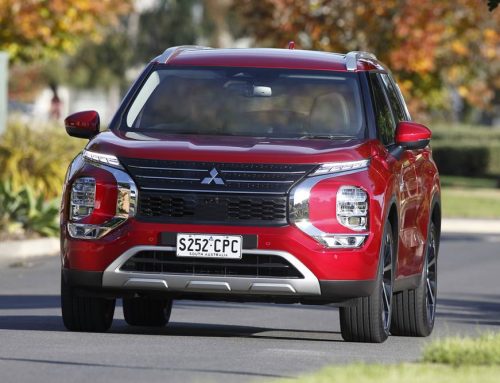
Mitsubishi has been working with JET Charge for some while, but the EV infrastructure business is now tied even closer to Mitsubishi, via the Outlander PHEV.
The new Mitsubishi Outlander Plug-In Hybrid Electric Vehicles (PHEVs) will be “JET Charge-branded”, and will be used by Jet Charge as part of their process, to be used in some innovative ways.
“We are excited to be further supporting JET Charge’s business journey in Australia,” said MMAL eMobility Manager, Tim Clarke.
“JET Charge has been a valued and long-term EV infrastructure supplier to our business, providing solutions for our vehicles, customers and the business as a whole.
From supplying domestic and AC fast-charging cables as standard equipment for our PHEVs, JET Charge has also been instrumental in supporting our broader eMobility projects, including the installation of EV infrastructure at our innovative Adelaide Head Office,” he said.
“JET Charge is proud to be working with Mitsubishi,” said JET Charge CEO, Tim Washington.
“The Outlander PHEV with its AWD performance and extended range provides our team adaptability and safety for important remote regional projects, where JET Charge are helping to build some of the world’s most remote EV charging sites in some of the harshest regions of Australia.
Video Review: Why 2023 Mitsubishi Outlander PHEV EV is the Best SUV EV on the road – REVIEW – Alan Zurvas GAYCARBOYS
Video Review: 2023 Honda Civic Type Review VS Toyota GR Corolla – The Surprise Story – REVIEW – Alan Zurvas GAYCARBOYS
Video Review: Toyota GR SUPRA GTS Mini Review #toyotagr86 #gaycarboys Alan Zurvas GAYCARBOYS #shorts
- Top GayCarBoys Stories:
- Sexy Men Drive 2021 Toyota Yaris Cross
- 10 Sexiest MotoGP Motorcycle Riders
- DON’T Drive YOUR CAR until you’ve Checked if your AIRBAG will KILL YOU
- 10 Hottest Racing Drivers
- Top 12 Best Gay Lesbian LGBTI Luxury Cars
- Top 10 Gay Lesbian LGBT Cars
- Top 10 Gay Lesbian LGBT Sports Cars
- Top 15 gay and lesbian LGBT SUVs
- Talented Twinks – Callum Ilott Virtually Races Arthur Leclerc


ABOVE: 2023 Mitsubishi Outlander PHEV handover to Jet Charge
Speaking at the official first vehicle handover in Western Australia, MMAL’s General Manager of the South Australia and Western Australia regions Mark Edmonds added: “This partnership is truly national in scope and we are looking forward to showcasing the Outlander PHEV’s abilities across a wide range of regional use cases and state guidelines. We strongly believe PHEV is great technology for Australia today and we are delighted to be working with JET Charge to actively demonstrate this.”
One of the many problems with the rollout of EVs in Australia has been the shockingly slow increase in the number of charging stations. Adding to the problem is the fact that the maintenance of existing outlets has been patchy at best.
Mark Jeisman is JET Charge’s Business Development Manager in WA, and said the unique technical capabilities of the Mitsubishi PHEV are beneficial to JET Charge’s continued innovation in the EV charging space.
“As an example, Mitsubishi’s ability to support Vehicle to Grid (V2G) charging technology allows the JET Charge team and industry stakeholders to use Outlander PHEV’s for research and testing in this emerging area; one that may play an important role in Australia’s future energy needs.”
The successful trial of VTG technology in the ACT, used the onboard batteries in EVs to act as local power storage in clever grids. Power flowed in and out of the battery, to be used in the home, or the network, or in the car itself. This is the missing link in making EVs an integral part of the grid, as opposed to a perceived drain on it.
As we wrote recently, the Outlander PHEV expands into a space it occupies with almost no competition. Few EVs allow their power to be bi-directional, but the Outlander PHEV does. It also has onboard domestic power points to provide limited capability for appliances, laptops and anything else that can be used at home, to be used on the go. It could power a small campsite for example, with the engine cutting in only when the battery depletes to a level requiring a top up.
While the Outlander PHEV is not a “conventional” EV, nor is it a “conventional” hybrid, and that is its strength. On its own, the Outlander PHEV is an EV whose range is extended by use of a petrol engine. As part of an advanced grid, Outlander PHEVs could be linked to other storage solutions.
Clever grids link all batteries together as if they were one, whether the batteries are on a wall at home, in a car on charge, or are part of a mega-battery such as that in South Australia. The source of the power coming into the system can be renewable or fossil fuelled, but as the ancient generators are closed, renewables stand on their own.
As the grid envelops the Outlander PHEV’s battery, the battery could well be used to earn the owners an income. An owner charging at home with solar, becomes part of the solution, and a truly clever one at that. However, as long as the Outlander PHEV is plugged into a smart grid, it is part of that grid, whether at home, at work, in a car park, or on the streetside.
The idea is genius but will need massive investment, but even more importantly, massive education. Convincing people to allow their car to be used for the good of all, is not something that will come naturally.
The ultimate goal would be to have ubiquitous availability of smart grids, and the vehicles able to make use of them. It will take government and business to work together, so we look at this announcement with enthusiasm.
Other GayCarBoys SUV Stories:
- Suzuki Jimny is Everyone’s Must-Have. Here’s Why.
- Sexy Men Drive 2021 Toyota Yaris Cross
- Top 15 gay and lesbian LGBT SUVs
- Toyota Landcruiser VX: King of the Load
- LandCruiser Sahara: Your limo to the wild awaits.
- 2020 Landrover Defender: New, for the sake of it?
- Landrover Defender In Final Desert Testing
- 2020 Range Rover Evoque P250 R-Dynamic S VIDEO REVIEW
- Land Rover Around The World in 70 Days Challenge
- 11 Best Things about VW Amarok
- Amarok V6 is tops
- Toyota Hilux Rugged X Review and video
- Nissan Navara N Trek Warrior VS Toyota Hilux Rugged X down on the Farm.
- 2019 Toyota Hilux Rugged X Review, Road Test, and video.
- RAM 1500 Laramie VIDEO car review
- 2018 Ram 1500 Road Test and Review
- A Weekend Away in a Jeep Compass with 3 Hot Companions
- Is Jeep Gladiator a Backroom Bar on Wheels?
- 2018 Jeep Compass Limited Review
- 2020 Mitsubishi Pajero Sport Exceed review in the DUNES
- 2020 Mitsubishi Pajero Sport
- 2018 Mitsubishi Pajero Sport GLX Review
- Is 2023 Mitsubishi Outlander PHEV EV the Best Car on the Road






Leave a Reply